
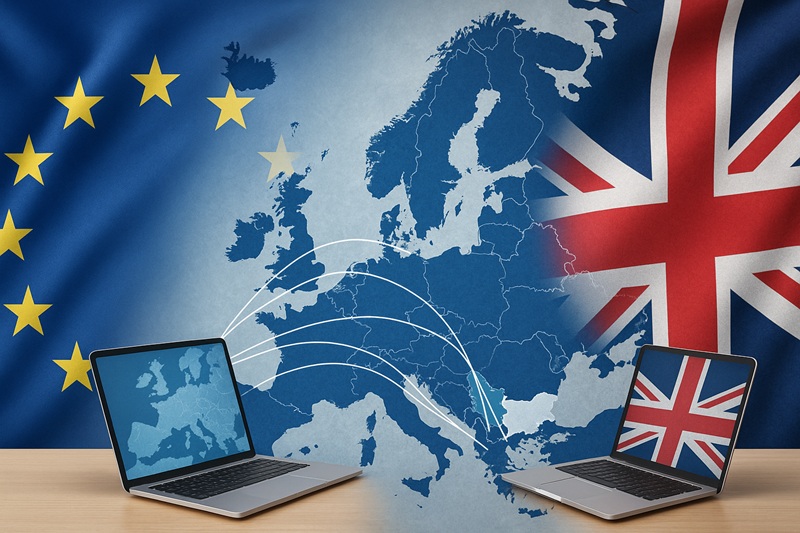
When the United Kingdom left the European Union, it not only redrew political boundaries but also reshaped the way money moves between the two markets. Before Brexit, payments between the UK and EU were simple domestic-like transactions under a unified regulatory framework. After Brexit, new conditions emerged — affecting processing times, fees, and legal responsibilities. Understanding these changes is essential for businesses, freelancers, and individuals who continue to operate across both regions.
Payments Before Brexit: A Unified System
Prior to Brexit, the UK was fully integrated into the Single Euro Payments Area (SEPA) under EU law. Transfers between EU and UK banks were treated as internal euro transactions:
- Fees were minimal or zero.
- Processing times were short, usually within one business day.
- Compliance rules were harmonized through PSD2 (Payment Services Directive 2).
This environment allowed trade, e-commerce, and remittances between the UK and EU to flow without friction.
After Brexit: A Shift in the Legal and Banking Framework
When the transition period ended in 2021, the UK became a “third country” under EU law. While it remains a non-EU SEPA member, its participation now depends on compliance with SEPA’s technical and legal standards rather than automatic inclusion.
This change introduced several consequences:
- Some EU banks began treating UK payments as international transfers, applying higher fees.
- Currency conversion between GBP and EUR became a major factor.
- Additional compliance checks appeared for anti-money laundering (AML) and sanctions screening.
In short, although SEPA connectivity continues, the level of convenience that existed before Brexit no longer applies uniformly.
The SEPA Status of the UK
The UK retained access to SEPA under the European Payments Council (EPC). This means:
- UK banks can still process euro-denominated transfers within SEPA standards.
- Payments must be made in euros and use IBAN and BIC identifiers.
- UK payment institutions must continue following EPC Rulebooks for security and data integrity.
However, not all EU banks treat the UK equally. Some now categorize it as “non-EEA,” resulting in added service fees or extended processing times. This inconsistency has created uncertainty for businesses that depend on predictable payment costs.
Currency Conversions and Exchange Volatility
One of the most noticeable impacts of Brexit is the increased exposure to currency fluctuations.
Before 2020, many cross-border contracts were settled directly in euros through SEPA. Now, with the pound sterling fully separated from EU monetary policy, exchange rate volatility between GBP and EUR has grown.
Companies engaged in cross-border trade now adopt several strategies:
- Holding dual-currency accounts in both GBP and EUR.
- Using multi-currency payment platforms to manage conversions efficiently.
- Locking in rates through forward contracts to protect against sudden currency swings.
Frequent rate changes can significantly influence the profitability of import/export operations, especially for small and medium-sized enterprises.
Fees and Transaction Costs
While SEPA transfers remain possible, many banks now apply international fee structures to UK–EU transactions.
For example:
- Some EU institutions charge €5–€15 per transfer, even within SEPA.
- UK banks may add FX margins of 1–3% for euro conversions.
- Correspondent bank fees can appear if routing through intermediaries.
Fintech platforms have filled the gap by offering borderless payment accounts and local collection options that bypass traditional interbank charges. Companies operating frequently across the Channel often prefer these solutions for cost predictability.
Compliance and Data Protection Requirements
Brexit also separated the UK’s financial and data protection regulations from the EU’s framework.
Key differences include:
- The UK no longer automatically applies the EU’s PSD2 directive.
- The EU’s GDPR still applies to EU-based data, while the UK enforces its own version: UK-GDPR.
- Cross-border payments must now comply with dual reporting obligations — one under UK regulators (FCA) and one under EU authorities.
This dual compliance structure has increased administrative overhead for multinational companies and payment providers.
Payment Delays and Intermediaries
Cross-border transfers between the EU and UK occasionally experience longer processing times due to additional compliance checks. Transactions may now pass through intermediary banks to handle FX conversions or sanctions screening.
These intermediaries can add both time and cost to transfers. Businesses that depend on fast settlements — for example, e-commerce vendors or logistics operators — have adapted by using fintech platforms capable of direct clearing through EU-based accounts.
Business Adaptation: Fintech as a Bridge
To minimize disruption, many companies have turned to fintech solutions that maintain banking infrastructure within both regions.
For example:
- A UK-based business may open an EU IBAN account through a fintech partner for euro transactions.
- An EU exporter may receive GBP payments locally through the same platform, avoiding SWIFT fees.
- Automated currency conversion tools optimize exchange timing and transparency.
This dual setup allows organizations to maintain “local presence” in both financial systems without opening multiple bank accounts.
Impact on E-Commerce and Online Platforms
Online merchants have felt the payment impact of Brexit more directly than traditional corporations. Many UK sellers that relied on EU payment gateways had to migrate to multi-region processors.
Issues include:
- Longer settlement times for euro payouts.
- Additional verification for VAT and compliance with EU digital service rules.
- Card issuers charging cross-border interchange fees that were previously capped under EU law.
Payment orchestration systems that automatically route transactions through the optimal provider now help merchants reduce fees and prevent declines due to geographic mismatch.
The Future of EU–UK Payment Relations
Despite early disruptions, the EU and UK are gradually stabilizing their financial relationship. Continued SEPA participation, combined with evolving fintech infrastructure, ensures that payments remain possible without major barriers.
Future improvements may come from:
- ISO 20022 adoption, aligning data standards across both systems.
- Wider use of instant payment schemes, including SEPA Instant and Faster Payments.
- Regulatory cooperation between the European Central Bank (ECB) and the UK’s Financial Conduct Authority (FCA).
The long-term goal is interoperability — ensuring money can move smoothly between both sides despite political separation.